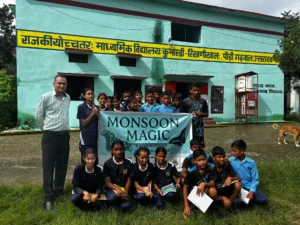
Empowering the next generation: Chakhuli volunteers conducting a “Monsoon Magic” awareness session at a local school in the Kalagarh landscape.
The northern boundary of Jim Corbett National Park hides landscapes that many travelers never see.
Away from the busy tourism zones lies a quiet forest region called Kalagarh Tiger Reserve. This landscape is home to dense forests, the Mandal river valley, small Himalayan villages, and hundreds of bird species.
One such village is Rathuwadhab.
This small village sits on the northern side of Corbett and shares its boundaries with forests that still hold elephants, leopards, deer, and over 370 species of birds recorded in the region.
From this landscape, a small community initiative began.
That initiative is Chakhuli.
Chakhuli is a community-driven nature conservation initiative started by local nature guides from Rathuwadhab village in the Kalagarh landscape.
The initiative was founded by young nature enthusiasts including Shiwank Negi along with other local bird guides and community members.
The idea behind Chakhuli is simple:
If local people understand nature, they will protect it.
Instead of waiting for outside organizations to create change, Chakhuli focuses on grassroots conservation — working directly with local communities, children, and villagers living around the forest.
Most tourists visiting Jim Corbett National Park only know popular zones like Dhikala or Bijrani.
But the northern boundary of Corbett, located inside Kalagarh Tiger Reserve, remains one of the most unexplored regions of the landscape.
This region includes:
For generations, local communities here have lived alongside wildlife. Human-wildlife coexistence is not a concept here — it is daily life.
Why Chakhuli Started
Even though the forest surrounds these villages, many local children grow up without understanding the ecological importance of the wildlife around them.
They hear birds every morning, but they don’t know their names.
They see forests every day, but they don’t know how important these ecosystems are.
Chakhuli began with one clear mission:
Nature education for local communities. The goal is to reconnect people with the landscape they already live in.
One of the core activities of Chakhuli is visiting local village schools around Rathuwadhab and the Kalagarh region.
During these visits, volunteers interact with students and introduce them to topics such as:
These sessions are simple and interactive.
Instead of lectures, students learn through pictures, bird calls, and stories from the forest.
When children recognize a drongo, barbet, or minivet, the forest suddenly becomes more meaningful.
And that connection is the first step toward conservation.
The forests around Kalagarh Tiger Reserve are among the richest bird habitats in northern India.
More than 370 species of birds have been recorded in the Kalagarh landscape.
Through bird walks and awareness programs, Chakhuli introduces both locals and visitors to the incredible birdlife of the region.
Bird watching becomes more than a hobby.
It becomes a way to understand forests.
Conservation cannot survive if local communities do not benefit from protecting nature.
Chakhuli strongly believes in community-based ecotourism.
Instead of large resorts, the focus is on:
One such example is The Corbett Rajae Homestay, a homestay run by local host Shiwank Negi.
The homestay promotes slow travel, bird watching, village experiences, and nature-based tourism in the Kalagarh landscape.
Visitors staying here explore the region through guided walks, bird watching trails, hidden waterfalls, and interactions with local communities.
This model helps ensure that tourism income directly reaches local people.
One of the major community initiatives connected with Chakhuli is the Kalagarh Nature Festival.
This event brings together:
Participants explore bird trails, attend conservation talks, and learn about biodiversity in the northern Corbett landscape.
More importantly, the festival highlights community-led ecotourism, where visitors stay in village homestays and experience the culture of the region.
Chakhuli is not a large NGO with big offices or corporate funding.
It is a small group of local people who believe that conservation must start from the ground.
From school awareness sessions to bird walks and community tourism, the initiative focuses on building a deeper connection between people and the forests around them.
Because in landscapes like Corbett, the future of wildlife and the future of local communities are closely connected.
The forests around Kalagarh Tiger Reserve still hold immense biodiversity.
Elephants walk ancient forest paths.
Leopards move silently through the hills.
Hundreds of birds fill the forest canopy.
But conservation will only succeed if the next generation grows up understanding the value of these ecosystems.
Chakhuli exists for that reason.
To ensure that the forests of Corbett are not only protected by laws, but also by the people who live closest to them.
Leave a Reply